


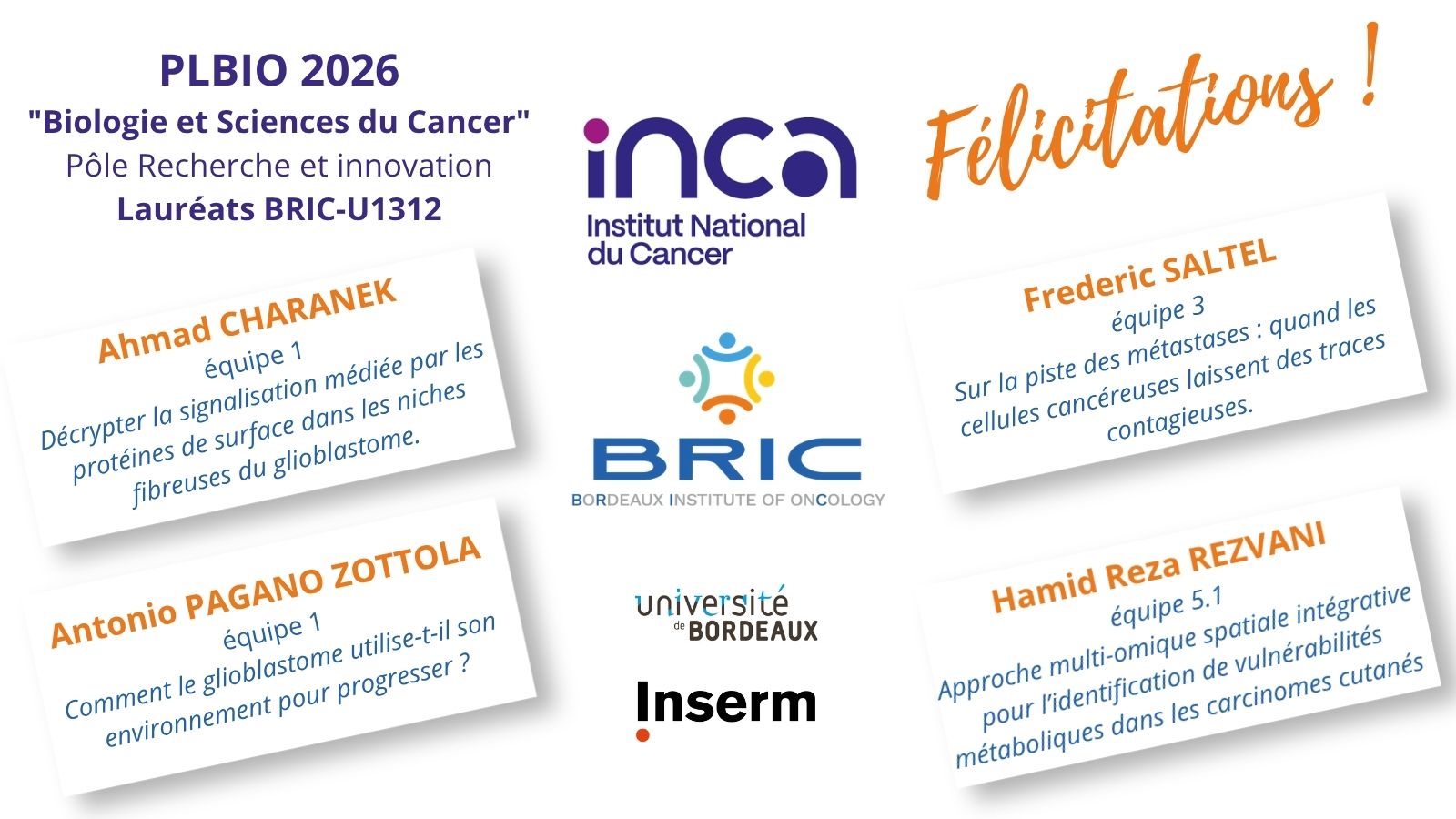
04 Sep 4 BRIC projects awarded INCa funding under the PLBIO2026 program
The National Cancer Institute (INCa) has announced the results of the PLBIO 2026 call for proposals—Biology and Cancer Sciences: 54 basic research projects have been funded to advance the fight against cancer.
For more than 20 years, PLBIO has been one of INCa’s flagship programs, supporting ambitious projects, promoting multidisciplinary approaches, and encouraging the exploration of new scientific avenues—all of which are essential for future advances.
By funding this research, the National Cancer Institute is investing in world-class research—one of the pillars of the 2021–2030 Decade-Long Strategy to Combat Cancer—that can shed light on the mechanisms of cancer, lead to the development of new tools, and open up new diagnostic and therapeutic avenues.
👏 Congratulations to the 54 winners; you can find more information about them on the INCa website.
Within our unit, we are pleased to have four selected project leaders!
– Ahmad Charanek, équipe 1 – BRAINSTRIM Brain tumor stroma, resistance, invasion and metabolism
– Antonio Pagano-Zottola, team 1 – BRAINSTRIM Brain tumor stroma, resistance, invasion and metabolism
– Frederic Saltel, team 03 – Liver Cancers and Tumor Invasion
– Hamid Reza Rezvani, team 05 – Translational Research In Oncodermatology and Orphan skin diseases (TRIO2).

BRIC team 1

BRIC team 3
Decoding surface protein-mediated signaling in fibrotic glioblastoma niches.
Glioblastoma is the most aggressive brain cancer in adults and remains incurable. Our project aims to understand how collagen-rich fibrotic niches within the tumour microenvironment support glioblastoma stem cells and promote tumour progression and treatment resistance. The goal is to identify new therapeutic vulnerabilities and develop strategies to disrupt these protective interactions between tumour cells and their microenvironment.
The project, led by Dr Ahmad Charanek (INSERM U1312, BRIC), will be conducted in collaboration with Dr Audrey Burban (IBGC, CNRS UMR 5095), Dr Gilles Guichard, and Dr Emmanuelle Thinon (CBMN, CNRS UMR 5248). The project benefits from funding of €778,220, primarily dedicated to personnel recruitment and operating costs required to carry out the research.
Tracking Metastasis: A New Clue in How Breast Cancer Spreads
Metastasis remains the leading cause of death in breast cancer. Our research shows that moving tumor cells leave behind tiny membrane fragments on collagen fibers, a kind of “trail” called ColTracks. These trails can transform neighboring, previously harmless cells into invasive ones capable of spreading. We now aim to understand how these trails work and identify the key molecules involved, while also studying patient samples. This new mechanism could lead to biomarkers and therapeutic targets to help slow breast cancer progression. Project in collaboration with Dr Reini Luco (Curie Institute).

BRIC team 1

BRIC team 5
How does glioblastoma use its environment to progress?
Glioblastoma is one of the most aggressive brain tumors. Our project focuses on its interaction with myelin, a lipid-rich substance that surrounds nerve fibers.
We aim to understand how tumor cells use components of myelin and how these interactions may promote tumor invasion.
Supported by €829,224 in funding over 48 months for personnel and operating expenses, the project is carried out in collaboration with Thomas Daubon (CNRS UMR 5095/ University of Bordeaux) and Michel Salzet (Inserm U1192 / University of Lille).
Integrative spatial multi-omics for the discovery of metabolic vulnerabilities in cutaneous carcinomas.
Reprogramming of energy metabolism is a hallmark of tumor initiation and progression. While well-established in many cancers, metabolic rewiring in cutaneous squamous cell carcinoma (cSCC) and its precursor actinic keratosis (AK) remains largely unexplored. This multidisciplinary project aims to define the metabolic programs driving AK-to-cSCC progression and functionally validate therapeutic targets shared across tumor and immune compartments.
Supported by €625K in funding over 36 months for personnel and operating expenses, the project is being conducted in collaboration with Macha Nikolski (IBGC-CNRS/University of Bordeaux).

