


- Cet évènement est passé.
Séminaire invité – Reini Luco – 06-07-2026
6 juillet à 11h45 - 13h00
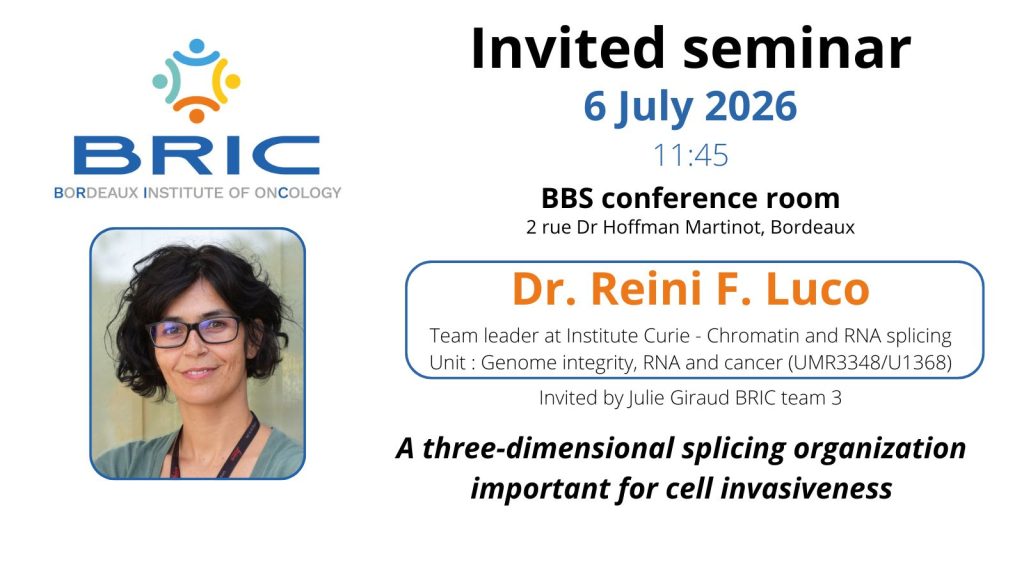
Julie Giraud et l’équipe 3 de BRIC invitent Dr. Reini F. Luco, responsable d’équipe Chromatine et épissage des ARN de l’unité Intégrité du Génome, ARN et Cancer (UMR3348 / U1368) à l’Institut Curie à donner un séminaire ouvert à la communauté scientifique.
A three-dimensional splicing organization important for cell invasiveness.
Lundi 6 juillet 2026, 11h45 salle de conférence BBS.
Biographie.
Dr. Luco’s scientific journey began at the Hospital Clinic of Barcelona, where she completed her PhD in Jorge Ferrer’s lab, investigating how histone modifications organize genes within nuclear space in the context of inherited diabetes. She then pursued postdoctoral research at the NIH in Tom Misteli’s lab, where she contributed to pioneering work revealing that chromatin not only regulates DNA but also plays a key role in RNA splicing. In 2013, she established her own research group at the Institut de Génétique Humaine in Montpellier, where she expanded her work on how histone marks shape cell type–specific splicing programs through the development of innovative CRISPR-based epigenetic and RNA editing tools. Now based at the Institut Curie in Paris, her group is exploring how this chromatin-mediated splicing regulation contributes to cancer cell invasiveness and the early steps of metastasis.
Résumé.
Metastasis and treatment resistance remain the main causes of cancer-related mortality. A major challenge is to target aggressive cells early enough, before their plasticity enables adaptation through EMT reprogramming. In this context, the key issue is not only which genes are expressed, but also how they are processed into different isoforms. Alternative splicing can rapidly rewire protein function without major transcriptional changes and has emerged as a critical regulatory layer in EMT and cancer progression. Indeed, splicing signatures often outperform gene-expression patterns in identifying poor-prognosis cancers, suggesting that isoform regulation may better capture the functional adaptations underlying aggressiveness. Yet it remains unclear how transcriptional and splicing programs are activated so rapidly and in a coordinated manner during EMT. We have previously shown that chromatin is a major regulator of splicing dynamics. Using CRISPR–dCas9 epigenome editing, we demonstrated that exon-localized chromatin marks can drive EMT-associated splicing switches by modulating recruitment of the splicing factor PTBP1 to pre-mRNA. Using an adapted CRISPR genomic screen and antibody-based proximity labeling approaches, we now propose that invasive reprogramming depends on a dynamic 3D chromatin organization that coordinates transcriptional and splicing regulation through specialized hubs. Distrubing these hubs could be an innovative strategy to target metastasis at its source.

